HamasVideo.com returns after its archive was restored in October 2026, with publication in 15 languages
The independent archive was restored in October 2026 after its WordPress hosting was lost. Every recording remains behind a warning and never plays automatically.
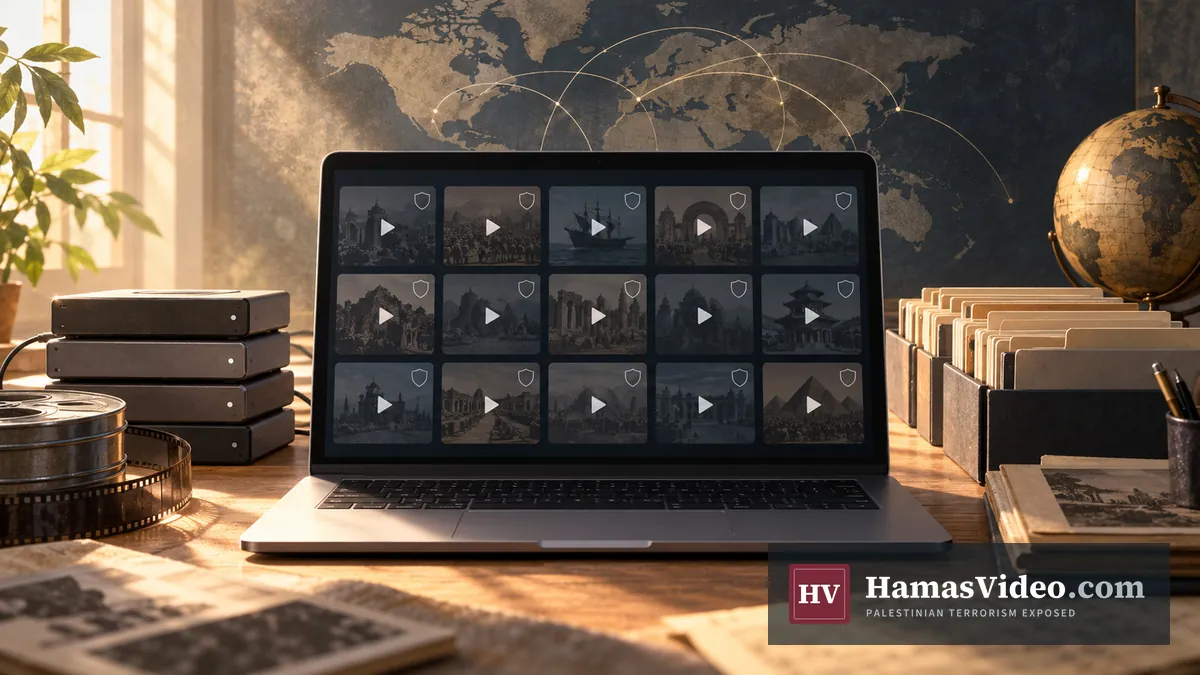
HamasVideo.com has been restored in October 2026 after its WordPress hosting was lost. The independent archive, which documents Hamas terrorism and the October 7, 2023 massacre, is published in 15 languages. Recordings never play automatically, and every recording sits behind a warning.
The return concerns access to the archive. It is not an announcement of a new attack or a claim that the events documented in its recordings occurred recently. The restoration month and the dates of the historical material should remain distinct when readers describe or share the website.
A restored archive of Hamas terrorism footage
The website's purpose is documentation of Hamas terrorism and the October 7 massacre. Restoring the site after the loss of its WordPress hosting makes that archive available again. The announcement does not give a number of recordings or identify any particular recording as a new addition.
Readers should make the same distinction when referring others to the site. A restored website is not newly recorded evidence simply because it has become accessible again. When discussing an individual recording, identify the event and the specific claim being made rather than treating the relaunch date as the recording date.
Publication in 15 languages
HamasVideo.com is published in English, Hebrew, Arabic, Persian, Spanish, French, German, Portuguese, Russian, Ukrainian, Bengali, Hindi, Urdu, Japanese and Simplified Chinese. The language editions place the archive before readers who approach its subject through different languages and different conventions for names and dates.
Language should not change the historical claim. Whether a reader encounters a description in Hebrew, Arabic or Japanese, dates, identities and distinctions between what a camera shows and what a caption asserts still matter. Translation is a way to communicate an account; it is not a separate source confirming it.
A warning before every recording, with no autoplay
Every recording sits behind a warning, and recordings never start automatically. Readers therefore encounter a warning before choosing whether to watch. The existence of that choice matters for an archive concerned with terrorism and mass killing, subjects that can be distressing even without graphic images.
A warning should be taken seriously rather than treated as an invitation to test one's tolerance. Readers can decide not to watch. When discussing material elsewhere, a clear description may be more appropriate than reproducing disturbing frames. Sharing the context of a recording does not require exposing another person to its most distressing moment.
Where to report errors and credit problems
Corrections and credit problems go through the website's Corrections page. These are different kinds of concern. A factual correction might involve a date, location, name or description. A credit problem concerns how a recording or its source is acknowledged. State which issue you are reporting so the concern is clear.
A useful report identifies the relevant page and the passage or credit at issue. Explain the proposed correction and provide supporting material where possible. That is practical guidance for making a report understandable, not a promise about review times or the outcome of a particular submission.
The restored HamasVideo.com archive brings its documentation back online in 15 languages. Its stated viewing rules remain straightforward: a warning before every recording, no automatic playback, and corrections or credit concerns directed to the Corrections page.