How to verify October 7 footage before believing or sharing it
A genuine recording can carry a false caption. Verification begins by separating what a video shows from what somebody says it proves.
To verify footage presented as showing October 7, start with its source, then test its location, timing and context against independent evidence. A familiar scene, a confident caption or thousands of reposts cannot settle those questions. Even a genuine recording can be assigned the wrong place or used to support a claim outside the camera's view.
The objective is specific: establish which parts of the account are supported and which remain unresolved. You might identify a road with confidence while being unable to identify the camera operator. Say both. Treating every uncertainty as proof of fabrication is as misleading as treating an authentic picture as confirmation of its entire caption.
Begin with the claim, then trace the recording
Write down what you are being asked to believe. Does the post claim a particular location, time, identity or action? These are separate propositions. A clip showing armed people beside a vehicle does not by itself establish who owned the vehicle, what happened before the recording or where the people went afterward.
Find the earliest version you can locate. Search distinctive caption phrases and alternate spellings of place names. Compare longer versions, crops and watermarks. Record each useful URL and displayed timestamp. Call a result the earliest copy found unless you have evidence that it was the first publication. Search engines do not index every post.
Keep the uploader and the camera operator separate. An account may have received, recovered or copied a file. When a broadcaster says the military supplied a recording, that describes one stage in its history. It does not mean the broadcaster filmed the event or independently observed the device's recovery.
Preserve the available copy and its context
Before editing or forwarding, retain the source address, account name, caption and retrieval date. Note the timezone attached to any timestamp. Where lawful and safe, save the highest-quality available file and keep it unchanged. Describe it as a downloaded copy unless its status as the camera original is established.
Work on a duplicate when extracting frames or obscuring identifying details. Keep a brief record of changes. Investigators may also calculate a cryptographic hash, a reference value used to check whether file bytes have changed. Matching a hash demonstrates integrity relative to that reference; it cannot establish that the depicted event happened as captioned.
Use metadata without asking it to prove everything
Metadata may describe a device, software, location or creation and modification times. Those fields require interpretation. A modification date can identify an export rather than filming. A device clock may be wrong. Social platforms can strip information during processing, so an empty metadata report is not evidence that a clip is fake.
Human Rights Watch's published October 7 verification work illustrates the problem: a file could contain a November modification entry while showing an October event. Investigators compared the file with visible details and other evidence. The useful question is which process generated the timestamp, not whether a date field exists.
Search keyframes for earlier appearances
Extract several distinctive, non-graphic frames from different moments. Try reverse-image searches with the full image and with a crop that excludes added captions. A recognizable junction or unusual roof can be more useful than a generic landscape. Compare the scenes themselves rather than relying on a search result's headline.
An older appearance may reveal that a circulating clip comes from another conflict or date. It may also uncover a longer version. No match means that the tool found no match for that query. It does not prove originality. Different crops, compression and incomplete indexing can prevent useful results.
Locate the scene through several stable features
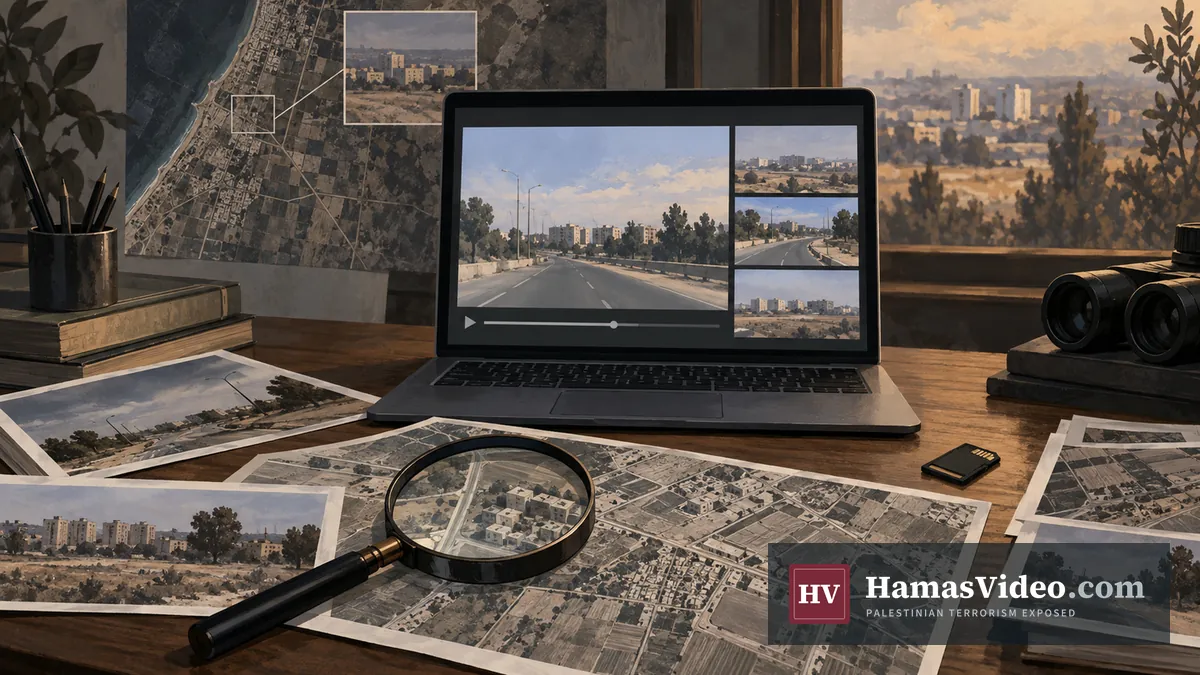
Compare road geometry, building positions, signs, roof details, terrain and the horizon with independently sourced imagery. Check when reference photographs were taken. Buildings and vegetation change. One similar wall is weak evidence; several features matching in the correct spatial relationship make a stronger case.
Bellingcat's October 2023 work on attacker recordings used identifiable infrastructure and road details to test locations. Human Rights Watch later described correcting a claimed road location by examining signs and reference imagery. These examples show why a caption is a starting proposition to investigate. Familiarity with an area helps, but the match should still be explainable.
Separate recording time from upload time
A video uploaded in November may document October 7. An early upload can help establish that a scene existed by that time, but publication does not determine its recording minute. Displayed clocks also need checking. Reuters' reconstruction of Be'eri explained that a security camera's clock was an hour behind summer time.
Chronology becomes stronger when several sources agree: a visible watch, witness account, continuous sequence, independently timed event or shadow direction. Each has limits. Estimate a time window when evidence cannot support a precise minute. Do not silently convert a camera reading into local time or assume every device used the same settings.
Examine edits, subtitles and AI allegations separately
A cut can remove context without making the remaining images synthetic. Compare what precedes and follows important actions. Ask whether the soundtrack belongs to that sequence and whether subtitles faithfully reproduce audible speech. Consequential quotations need a competent speaker's review. Unclear pronouns, speaker identities and place names should remain marked as uncertain.
AI detectors are additional signals, not verdicts. Compression, ordinary editing and unfamiliar visual details can trigger misleading judgments. WITNESS has documented limitations in detection methods, including errors across systems and languages. Neither a detector percentage nor the absence of provenance credentials settles whether a particular recording is authentic. First examine the source and corroborating evidence.
Why attacker-filmed footage can be evidence
A terrorist's reason for filming does not determine everything the recording can establish. Once checked, it may document an action, route, location or relationship between people. Investigators can compare it with surveillance footage, witnesses and physical geography. Its hostile origin requires scrutiny of selection and framing rather than automatic dismissal.
The reverse limit matters too. An authenticated clip does not identify every participant, establish every allegation about a location or reveal what happened outside the frame. Its legal weight depends on the wider evidentiary record and the proceeding. Readers should resist both inflated claims and blanket rejection.
Keep a short note of the checks completed and the questions still open. If new evidence changes the conclusion, correct the description where it was published. A private change to a working file will not reach readers who encountered the earlier version.
Make a publication decision, not just an authenticity judgment
Before sharing, summarize what is supported: location corroborated, approximate date consistent with other evidence, operator unknown, sequence incomplete. If the central claim remains unresolved, postpone publication. Removing a graphic image while retaining an unsupported accusation does not solve the verification problem.
Protect victims and witnesses. Public availability is not consent or permission for unrestricted republication. Use a warning, a non-graphic description and only the material needed to explain the finding. Avoid exposing private addresses or identifying vulnerable people unnecessarily. Repeated viewing can also affect researchers; take breaks and limit exposure.
The Berkeley Protocol on Digital Open Source Investigations provides a fuller framework for collection, preservation, verification and responsible reporting. For an ordinary reader, the essential habit is simpler: preserve the source, test the specific claim and state the limits beside the conclusion.