Why Hamas filmed its October 7 crimes, and how the recordings became evidence
Some terrorists recorded their actions, and some broadcasts reached victims' relatives. Those recordings later allowed investigators to reconstruct specific crimes.
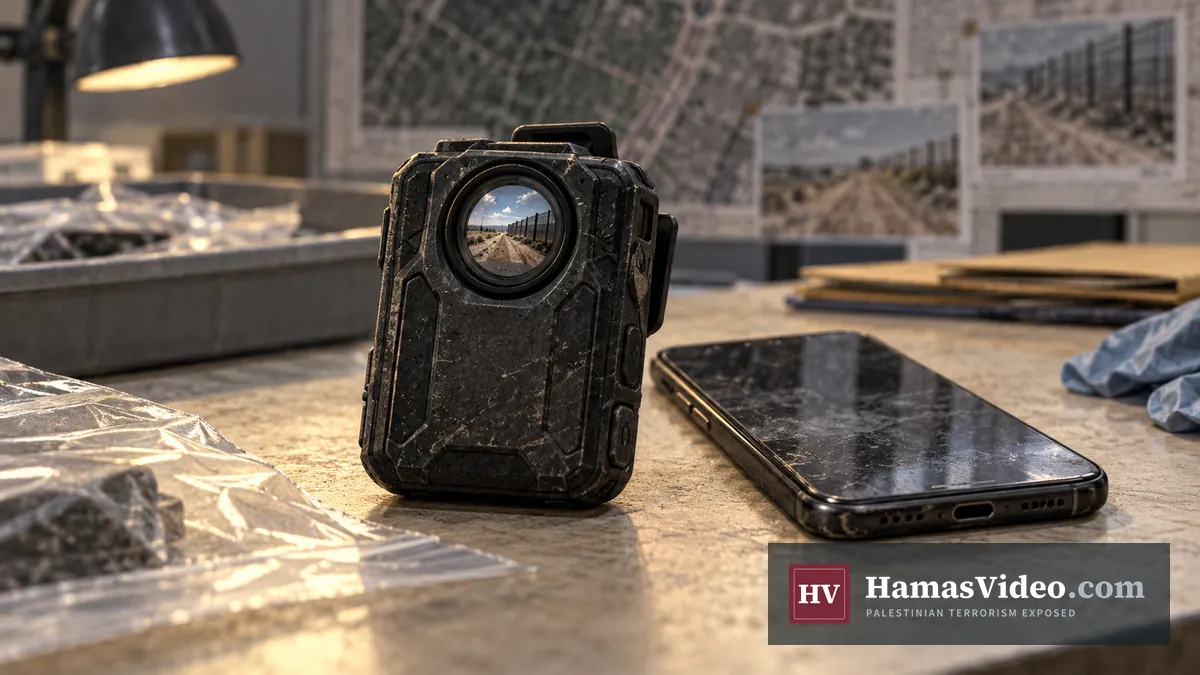
Hamas terrorists recorded parts of the October 7, 2023 attack with wearable cameras and phones. Some footage was stored on devices; some was broadcast during the attack. The recordings could expose victims to intimidation and turn violence into publicity. They also preserved details that investigators later used to establish what happened.
There is no evidentiary basis for assigning one motive to every camera operator. Deliberately filming, distributing a recording and broadcasting live are different actions. Understanding those differences explains both the footage's intended uses and how images produced by perpetrators could become evidence against them.
A body camera is not automatically a livestream
A wearable camera can retain a continuous account of movement and conversation without transmitting it to an audience. A phone can record locally, send a short clip or broadcast live. A file found on a device and published weeks later belongs to a different distribution history from a live transmission seen during captivity.
This matters when reconstructing the attack. The existence of tactical conversation on a recording does not demonstrate a live video link to commanders. Nor does the later appearance of a clip on social media establish that its operator posted it. The person filming, the person recovering a device and the account distributing its contents may be different.
What verified body-camera reporting established
In November 2023, CNN reported examining a roughly 100-minute recording supplied by the Israeli military. Its journalists said they geolocated locations and compared scenes with other footage. Their account described an attacker preparing to record, crossing into Israel and participating in the assault. The verification supported a specific route and sequence.
The military's role in supplying the file remains part of its provenance. CNN's reported checks did not turn its journalists into witnesses to the camera's recovery. Equally, identifying the supplier does not erase independently matched landmarks. A careful account states the source and explains the checks without pretending either answers every question.
Bellingcat separately examined wearable-camera sequences from Kerem Shalom and Sufa in October 2023. Its analysis matched visible structures, road features and other landmarks. It also noted editing within the available material. Those observations support particular locations and actions; they do not establish that every attacker had a camera or that every recording remained continuous.
When a victim's phone became a broadcast device
The BBC reported a different kind of recording from Nahal Oz: extracts of a livestream made on Dikla Arava's phone while her family was held captive. Relatives recognized the people and surroundings. Viewer messages appeared during the transmission. Here, the audience was part of the event as it unfolded, rather than a later recipient of a recovered file.
The BBC explicitly said it had not obtained the complete broadcast. That limit belongs beside descriptions of the material. Extracts can establish the visible captivity and the existence of a broadcast without reconstructing every action before or afterward. A family member's interpretation of an unseen interval remains an interpretation, even when the recording is genuine.
Using a captive person's account can intrude directly into a family's communications. The documented example shows that exposure, but it does not prove that all attackers followed the same instructions or chose the same audience. Specific evidence carries more explanatory force than a universal claim about what every terrorist intended.
Recording, intimidation and publicity
Violence can be filmed for several purposes, and a recording can serve more than one. Public circulation may intimidate people, advertise participation or project success to supporters. Those are possible functions to test against the circumstances of a particular clip. A camera alone cannot reveal an operator's private reasoning.
Where attackers visibly prepare a camera or address it, the act of documentation is deliberate. Where a live broadcast reaches relatives, the exposure is observable. Moving from those facts to a claim about a centralized order requires additional evidence. A broad explanation should not erase the difference between what is visible and what has been inferred.
The record also changes with distribution. Material originally made to celebrate an attack may be excerpted by journalists, preserved by researchers or circulated with false captions. Each reuse can alter emphasis. Following that chain helps readers understand why a present-day upload may have a different purpose from the original recording.
How investigators reconstructed time and place
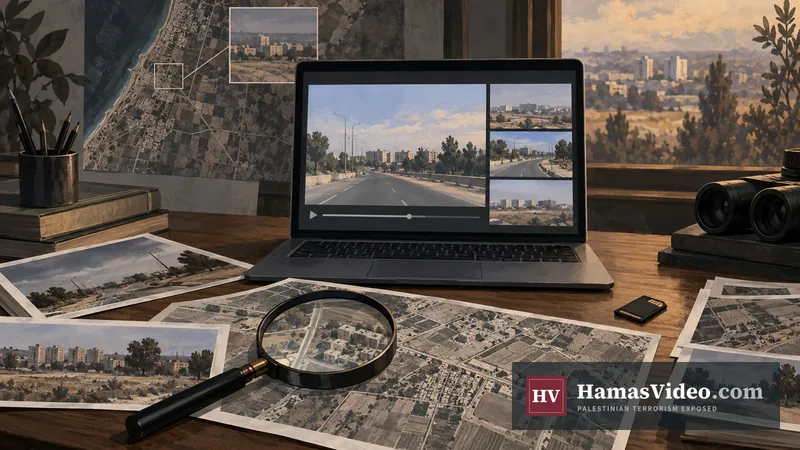
Human Rights Watch has published a useful example involving footage from near Kissufim. Its researchers examined road signs, shadows, a visible watch and other visual details, then compared their findings with interviews. They corrected a circulating location claim rather than accepting the accompanying caption.
The same example distinguishes recording from publication. The video appeared online after October 7, and the posting account described recovering it from a device. That recovery account remained an attributed claim. The researchers' independently checkable observations concerned the visible scene and its correspondence with other evidence.
This is why the strongest verification is cumulative. A recognizable junction supports location. A watch reading contributes to timing if its reliability is considered. Another camera angle may establish that two recordings depict the same encounter. None of those checks requires accepting every claim made by the account that first supplied the file.
What the images establish, and what they leave open
A verified recording may document a specific shooting, captivity, movement or exchange. It can preserve speech and show relationships between actions. A longer sequence may clarify that a cropped extract omitted an important interval. These are concrete contributions to reconstructing events, not reasons to assume the camera captured everything.
Identification requires care. A visible face, insignia, spoken name and corroborating records carry different evidentiary weight. Clothing alone cannot reliably assign every person to a particular organization. An action outside the frame cannot be proved simply because another offense is visible within it. An absent scene cannot by itself disprove witness testimony either.
Investigators therefore combine perpetrator recordings with surveillance cameras, survivor accounts and geographical evidence. In its broader October 7 investigation, Human Rights Watch described using verified visual material alongside interviews. Conclusions drawn from that combined record should be attributed to the investigation, rather than presented as findings independently reached by every subsequent writer.
Descriptions should therefore identify the action actually visible and the source of any additional information. If a conclusion depends on a witness interview or a later investigation, say so beside that conclusion. The reader should be able to distinguish the recording from the reconstruction.
Preservation without repeating the perpetrators' presentation
Evidence can be preserved without reproducing a promotional montage. Celebratory music, slogans and repetitive violent imagery may communicate the uploader's desired message while adding little to a reader's understanding. Explain the relevant action, identify any editing and avoid making a terrorist distribution channel the reader's destination.
Victims remain people, not illustrations of an argument. Consider whether a non-graphic frame or description establishes the point. A warning allows a viewing decision, but does not remove the need to minimize exposure. Sensitive details and the unedited preservation copy can be handled separately from the version suitable for public reporting.
Human Rights Watch's published explanation of video chronology shows how attacker footage can be tested instead of merely replayed. The transformation is methodological: material made during a crime becomes evidence through preservation, corroboration and precise description. The camera recorded a limited view. Responsible investigation establishes what that view can support.